

The NRL’s record broadcast agreement appears to preserve Australia’s established sporting order. Look more closely, however, and it reveals how thoroughly that order has already changed.
Part one of a two-part series on the changing sports-media landscape.
When the NRL announced its new seven-year, $5.3 billion media rights agreement, the obvious story was the deal’s size. Beginning in 2028 and running until the end of 2034, it overtakes the AFL’s current agreement, making rugby league’s broadcast package the most valuable in Australian sport. Nine retains the free-to-air and free-streaming rights, while Foxtel and Kayo remain the principal subscription home of the competition. On the surface, it looks like continuity: the same sport, the same broadcasters and a familiar division between free and paid coverage.
Yet the names on the announcement conceal a broader transformation. Nine is no longer simply a television network, and Foxtel is no longer merely a pay television operator. Nine operates across linear television, 9Now, Stan and Stan Sport, while Foxtel now sits within DAZN, the global sports-streaming company that completed its acquisition of the Australian business in April 2025. The NRL has not resisted the streaming revolution. It has signed with two media ecosystems that still use familiar Australian brands.
For years, the future of sports broadcasting has been framed as a contest between traditional television and streaming. The assumption was that technology companies would eventually displace broadcasters, as streaming disrupted scheduled entertainment television. Australia’s sports market is moving differently. Established broadcasters have integrated streaming into their businesses, while a global streaming platform has acquired one of the country’s most important legacy media companies.
The revolution has arrived. It simply did not arrive wearing a new logo.
Australia Did Not Follow the American Playbook
International discussions on sports media often highlight large tech firms. Amazon has integrated live sports into Prime Video, streaming events like the NFL, NBA, WNBA, NWSL, and NASCAR in the US. Apple has focused on rights for Major League Soccer and, starting 2026, Formula 1 in the US. These trends led to the expectation that Australia’s upcoming major rights auction would see a foreign platform securing a premium competition, potentially displacing local broadcasters.
The NRL agreement illustrates why that prediction was overly simplistic. Technology firms don’t need to secure every major deal to reshape the market; their involvement influences how traditional media companies must evolve. Nine can’t view the NRL solely as content for Channel 9. Instead, it should consider free streaming via 9Now, audience registration, advertising, cross-promotion, and the broader value of sport to its subscription model. Foxtel can’t treat the competition just as programming within a cable bundle; it must leverage the NRL to boost Kayo, retain subscribers, innovate new products, and connect Australian sports to DAZN’s global network.
Under the agreement, Nine will continue to broadcast three live NRL matches weekly, including finals, Test matches played in Australia, the grand final, and State of Origin. Foxtel and Kayo will air every home-and-away game and all finals except the grand final. Additionally, DAZN will expand the league’s international reach, with Foxtel planning to make NRL coverage available in 200 markets. This package offers a range of access points, from broadcast TV to free digital streams, domestic subscription services, and global distribution. It’s not just one broadcast deal but a coordinated system of various access options.
The Australian model differs from the typical narrative of television being overtaken by technology. Local broadcasters are now functioning as platforms, and an international one has infiltrated the local broadcasting scene. The line separating a television company from a streaming service is increasingly blurred.
From Broadcasters to Media Ecosystems
Sports rights were originally viewed primarily as a programming asset, with broadcasters acquiring competitions for their ability to draw large audiences, support advertising, and shape a channel’s identity. While these roles are still significant, the commercial value of sports has expanded to encompass a wider system of benefits.
Nine benefits from rugby league by reaching a large audience through Channel 9 and 9Now. It establishes scheduled viewing, offers a dependable platform for promotion, and maintains frequent engagement with viewers throughout much of the year. Although the NRL will not shift to Stan Sport under this deal, it enhances Nine’s position as a leading sports broadcaster. This reinforces their ability to promote other sports rights across their free and subscription channels, such as tennis, soccer, and netball.
Nine has characterised major sport as an experience that spans across the 9Network, 9Now, and Stan Sport, rather than being limited to a single channel. For instance, its Wimbledon coverage integrates select free broadcasts with comprehensive subscription content, on-demand options, and 4K streaming via Stan Sport. This approach is not a defensive move to protect traditional linear TV but rather an effort to utilise each platform to serve different aspects of the audience’s engagement.
Stan illustrates that Nine’s strategy goes beyond just defending broadcast TV. Stan Sport has broadened its football offerings with the Premier League and other events, and according to Nine’s February 2026 financial report, its average Stan Sport subscribers increased by 40% year over year. The company leverages free-to-air TV for wide reach and subscription services for depth. A major event can be available for free to a large audience, while an entire season or different sports are behind a paywall. The goal isn’t necessarily to convert every free viewer to a paid subscriber but to retain viewers within the company’s ecosystem.
Foxtel’s evolution is becoming increasingly clear. Once the dominant subscription TV provider in Australia, it primarily depended on sports as a key part of its bundled packages. Kayo has reshaped that sports component by shifting it from a traditional pay TV bundle to a direct-to-consumer streaming platform. With DAZN’s acquisition of Foxtel, the company now combines Foxtel, Kayo, and their production expertise into a global sports enterprise. The new NRL deal secures an important Australian subscriber base and offers DAZN content with international potential.
The ongoing relationship between Foxtel and Nine doesn’t indicate a lack of change. Although rights remain with established brands, these brands no longer represent the businesses they were a few years ago. Their strength now comes from combining traditional and modern distribution channels rather than choosing one over the other.
Why Free-to-Air Still Matters
The ongoing access to free-to-air coverage remains a crucial part of the agreement. Although some narratives about streaming’s rise imply that free TV is declining, sports show why this view can be somewhat misleading.
Free-to-air TV and free streaming extend reach in ways that subscription services can’t easily match. They introduce competition to casual viewers and dedicated fans alike, turning major matches into shared cultural moments. They also maintain a sport’s visibility beyond households that can or want to pay for additional services. For a sport aiming for national expansion, attracting new teams and developing stronger pathways, reach is closely tied to commercial value. It helps build the future audience that will later support subscriptions, ticket sales, sponsorships, and merchandise.
Nine’s package includes three weekly NRL matches and the biggest events on Channel 9 and 9Now. The grand final and State of Origin are still freely accessible, ensuring widespread access to rugby league’s premier moments.
The agreement also shows that “free access” is not a rigid concept. Starting in 2028, Nine’s package will feature 33 live NRLW matches, down from 66 matches in the current deal. A record-breaking overall agreement can increase a sport’s overall value while limiting free exposure in specific parts of the competition.
This tension merits careful thought. The future of sports media depends not just on whether a game is on TV or streaming, but also on which matches are free, which need payment, how easily viewers can switch services, and if the growth of women’s competitions is supported by comparable visibility.
Platform abundance does not always provide audience access. Sometimes it creates more layers through which access must be negotiated.
The Logos Are Familiar. The Strategy Is Not.
Although the NRL deal may be seen as a record-breaking financial achievement, its broader significance is structural. It indicates that the upcoming stage of Australian sports media won’t necessarily be defined by a quick takeover by Amazon or Apple. Instead, the more immediate change involves a consolidation around fewer, more influential media ecosystems that integrate free broadcasting, ad-supported streaming, subscriptions, audience data, promotion, and global distribution.
This benefits major sports by enabling competitions to keep free access while generating subscription revenue. They can collaborate with partners who have proven production skills, marketing strength, and large local audiences, as well as access to global platforms. Long-term contracts offer financial stability and give leagues and media companies the confidence to plan their products, schedules, and expansion over multiple seasons.
There are also risks involved. When rights are distributed across multiple services, audiences might struggle to understand what they need to watch a whole season. The financial pressure from record deals could eventually be reflected in higher subscription prices, increased advertising, or more content reserved for paying customers. Additionally, long contracts can tie competitors to specific commercial assumptions, even as viewing habits keep evolving.
The most significant competition might happen after the rights are signed. Nine needs to demonstrate that free broadcast services, 9Now, and Stan create a unified sports strategy. DAZN must decide how visibly it wants to sit behind Foxtel and Kayo, and how much it can expand Australian sports globally. Meanwhile, the NRL needs to weigh the financial benefits of the deal against the accessibility that initially increased the rights’ value.
The Next Revolution Is the Viewing Experience
The NRL agreement tells us who will manage and distribute one of Australia’s key sports assets. However, it doesn’t determine what sports viewing will be like in 2034. That issue is already evolving beyond the simple choice between a TV channel and a streaming service.
Apple’s Formula 1 approach in the U.S. integrates live broadcast rights with its broader ecosystem, such as Apple News, Maps, Music, and Fitness. Its collaboration with the NBA on Vision Pro indicates future viewing experiences featuring multiple games, immersive camera angles, spatial audio, live stats, and 3D visuals of gameplay.
These products are still emerging rather than mainstream, but they demonstrate how technology companies can influence sport even without securing Australian rights. They alter expectations around personalisation, interactivity, and immersion, which local rights holders will eventually need to address.
Currently, Australia’s sports-streaming shift may seem less flashy, but it is more impactful. This transformation occurs via corporate ownership, platform integration, and the reorganisation of well-known media companies. Channel 9 continues to resemble itself, and Foxtel and Kayo still appear as they did. However, beneath these interfaces, the market dynamics have evolved.
The debate has shifted from whether streaming will replace television to who manages the sports ecosystem, how viewers navigate between free and paid content, and what future charges companies will impose on audiences.
The NRL’s new agreement does not mark the end of traditional sports broadcasting. It shows that traditional broadcasting has already been rebuilt as something else.
Latest Posts
- A World of Pure Reimagination: What Netflix’s Wonka Tells Us About Its Future
 Fifty-five years after Gene Wilder first opened the doors to Willy Wonka’s chocolate factory, Netflix now invites audiences back inside. It features familiar visuals, the return of an original Oompa-Loompa, and a Wonka voice that resembles the original chocolatier many remember. However, the film and TV industry that existed when those doors first opened has…
 - Part 2: What My Conversation with Netflix’s Co-CEO Suggested About Netflix’s Next Phase
 Echoes of Screen & Streaming | Part 2 of a two-part series In Part 1 of this two-part series, I examined what my discussion with Netflix co-CEO Greg Peters revealed about Netflix’s shift beyond traditional streaming. The main point was that pressing play might become a launch, rather than a conclusion. Personalised discovery could connect…
 - Part 1: How My Conversation with Netflix Co-CEO Greg Peters Made Me Rethink What Streaming Means for Netflix’s Future
 Echoes of Screen & Streaming | Part 1 of a two-part series Last week, I met Netflix co-CEO Greg Peters at the company’s Sydney office during a small media roundtable with three other Australian journalists. The discussion covered live sports, AI, gaming, advertising, personalisation, interactivity, fandom, and physical experiences. There was no single announcement or…
 - Australia’s Sports Streaming Revolution Has Arrived — Just Not How We Expected
 The NRL’s record broadcast agreement appears to preserve Australia’s established sporting order. Look more closely, however, and it reveals how thoroughly that order has already changed. Part one of a two-part series on the changing sports-media landscape. When the NRL announced its new seven-year, $5.3 billion media rights agreement, the obvious story was the deal’s…
 - One Game, Three Broadcasts: What State of Origin Reveals About the Future of Sports Streaming
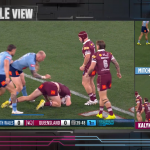 Throughout much of television history, sporting events served as communal experiences. Millions of viewers would tune in to the same broadcast, observe identical camera angles, listen to the same commentary, and follow a unified narrative created by the production team. Regardless of whether viewers were in a city or a regional area, their experience was…