
Throughout much of television history, sporting events served as communal experiences. Millions of viewers would tune in to the same broadcast, observe identical camera angles, listen to the same commentary, and follow a unified narrative created by the production team. Regardless of whether viewers were in a city or a regional area, their experience was fundamentally the same.
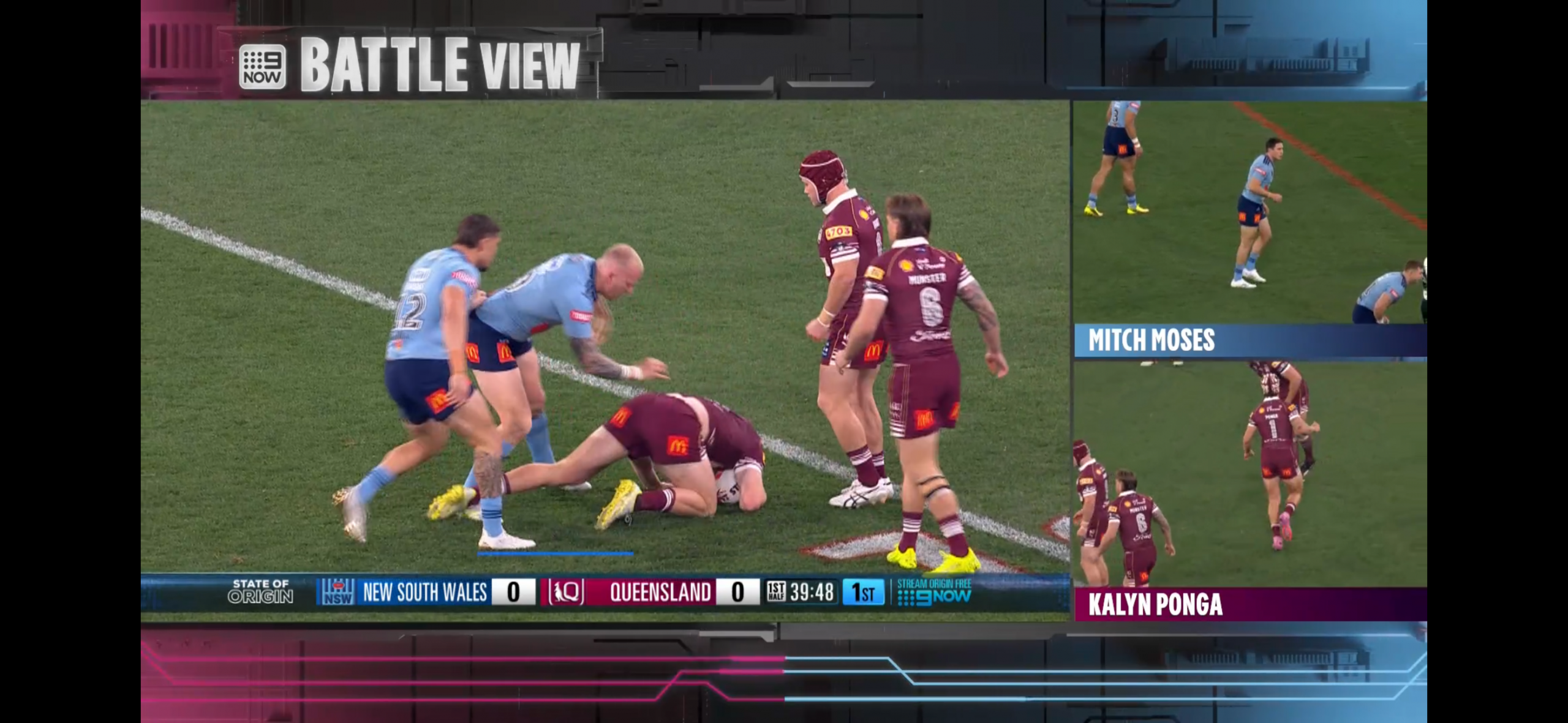
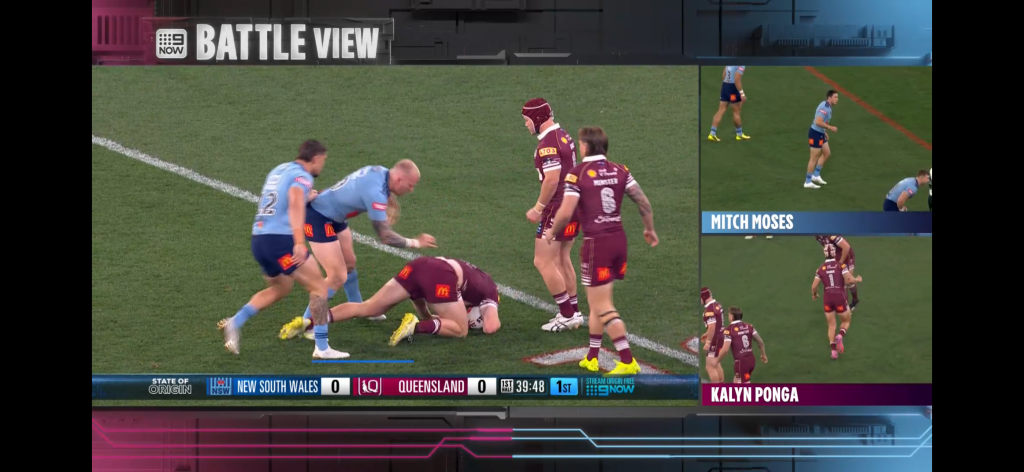
The recent State of Origin coverage questioned that assumption. Although the traditional Channel Nine broadcast was still accessible, viewers on 9Now could also choose different viewing options such as Battle View and Spidercam View. Battle View integrated the main broadcast with extra camera feeds focused on players, while Spidercam View provided a nonstop aerial view of the game.
The outcome was quite unusual. While audiences watched the same match, they didn’t all view the same broadcast. Initially, this might seem like a major breakthrough in sports broadcasting. However, what struck me most wasn’t the novelty of these options, but how familiar they appeared.
The Future We’ve Been Promised Before
The concept of giving viewers more control over sports coverage is not new. Historically, broadcasters have consistently explored ways to let audiences customise their viewing experience. In the late 1990s and early 2000s, interactive television services offered features like alternative camera angles, additional statistics, and improved coverage. The BBC’s Red Button service stands out as a prominent example, while Formula One enhanced its interactive viewing options with F1 Digital+ and later F1 TV. Similarly, Olympic broadcasts have adopted multi-stream viewing, enabling viewers to choose specific events or sports instead of relying solely on a broadcaster’s scheduled coverage.
In this context, State of Origin’s Battle View and Spidercam View are not groundbreaking. They represent the latest development in a long history of television’s efforts to control its audience. Interestingly, despite their introductions, these innovations seldom become mainstream. They often generate excitement and are promoted as the future of television, only to fade back into obscurity and remain on the fringes of the viewing experience.
Perhaps the key reason lies in what television excels at. While often described as a visual medium, television is also a form of curation. Viewers don’t just watch a sporting event; they see a version crafted by producers, directors, commentators, and camera operators. Every replay, close-up, crowd shot, and angle helps tell the story. The television director acts as an invisible storyteller, choosing what to highlight and when. This has been one of TV’s greatest strengths for decades, as it relieves responsibility from the viewer. Audiences can simply enjoy the event while someone else makes the decisions.
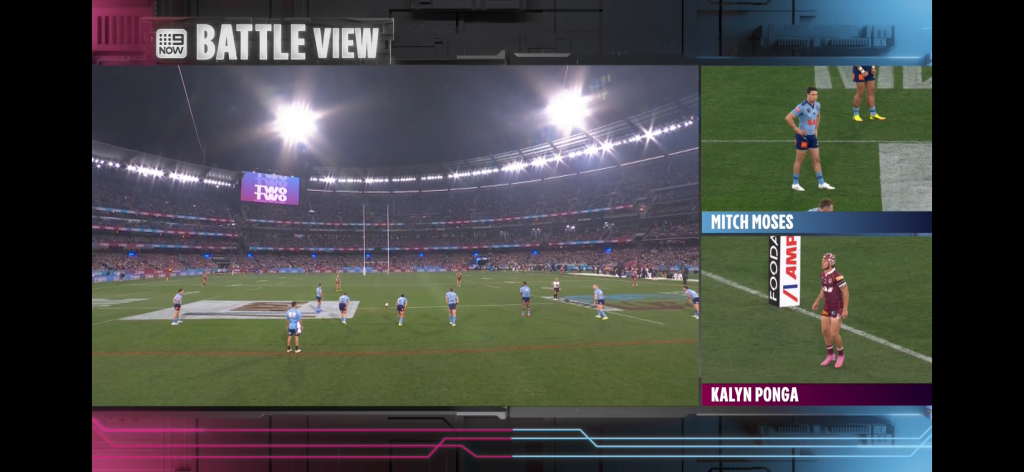
Battle View challenges traditional viewing by prompting viewers to engage more actively in their experience. It displays three different game elements simultaneously on one screen. Instead of depending solely on the production team, audiences are encouraged to split their attention across multiple perspectives, following details that might not be central in the main broadcast. This approach mirrors broader shifts in media habits, where streaming platforms have trained audiences to choose what, when, and where to watch.
More Screens, But Not More Insight
Having watched the State of Origin coverage across the available streams, I arrived at an unexpected conclusion. Battle View was arguably the least interesting way to watch the game.
The concept sounds compelling. Alongside the main broadcast, viewers could track two players via dedicated camera feeds. Theoretically, this would offer a richer view of positioning, movement, and off-ball activity. However, in practice, these extra screens rarely provided significant insights. Most of the time, the player cameras only showed athletes standing in defensive formations, jogging between plays, or waiting for the action. Although there were occasional interesting moments, these extra perspectives rarely added value beyond what the main broadcast already provided.
This underscores a key difference between technological innovation and editorial innovation. The technology functioned perfectly, but the issue was that the extra screens lacked engaging content. The picture-in-picture windows occupied valuable screen space that could have been utilised more effectively. For instance, a live Spidercam feed could display defensive setups and attacking patterns. A coach’s box camera might show reactions and strategic decisions. Bench cameras could offer insights into player interactions, substitutions, injuries, and team dynamics. Rather than merely replicating the main broadcast, these perspectives would enhance and complement it.
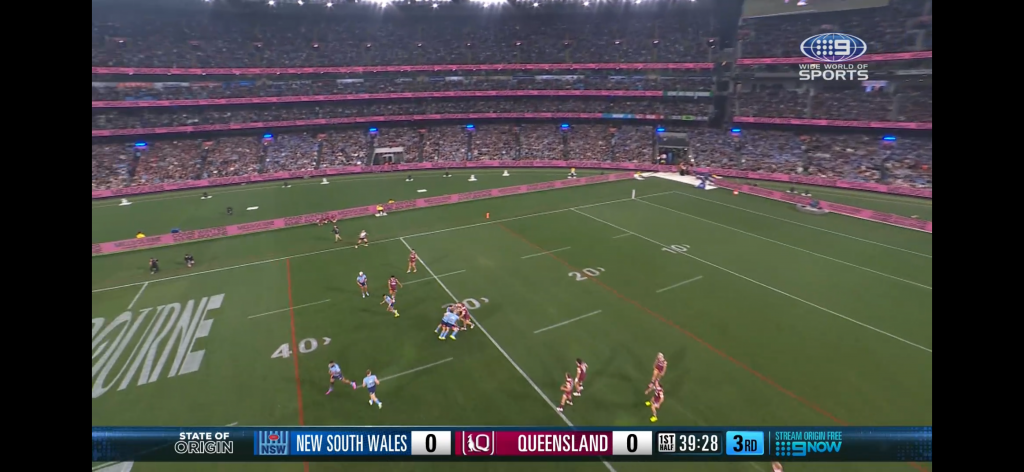
Spidercam View demonstrated this difference more effectively than Battle View. Unlike the player-focused feeds, the aerial perspective genuinely changed how the game could be understood. Traditional broadcasts are understandably focused on the ball and the moments of action that generate excitement. The Spidercam angle revealed something different. Defensive structures became easier to identify, attacking shapes emerged more clearly, and the relationships between players, space, and movement became far more visible than they are in conventional coverage.
Watching Spidercam felt less like spectating and more like analysing. Even this perspective raised questions about its value as a dedicated stream. While the aerial view offered useful tactical insights, it was not a perspective I wanted to watch for long periods. Instead, it worked best in short bursts, similar to how directors already use Spidercam shots within traditional broadcasts. The aerial angle provides context, but it rarely captures the drama, emotion, and narrative that keep viewers engaged throughout a match.
This led me to a broader question: if the best use of Spidercam is as a supplementary angle within the main broadcast, is there a need for a separate feed? The same applies to Battle View. While the technology functions well, having an extra stream doesn’t necessarily prove its worth. Maybe the future isn’t about developing separate viewing options, but about smarter ways to incorporate these alternative perspectives into the main broadcast.
The Streaming Rights Race and the Future of Sport
The broader importance of these developments might go far beyond just the State of Origin. Historically, major streaming services hesitated to dive into live sports, prioritising on-demand content, original shows, and binge-watching. Live sports were often seen as costly, complex, and not fitting the usual streaming approach.
That stance has shifted considerably. Sport now plays a crucial role in many of the industry’s major rights conflicts. Streaming platforms increasingly see live sport as one of the few content types capable of drawing large audiences at the same moment. More importantly, these companies approach media differently than traditional broadcasters. While TV networks have historically bought sports rights and adapted sporting events to conventional broadcast formats, streaming services focus on personalisation, platform design, audience data, and user choice.
This presents an intriguing prospect. As tech firms grow more influential in sports broadcasting, they might not just replicate traditional TV online. Instead, they could lead to entirely new ways of experiencing sports. For example, Formula One’s trials with Apple’s Vision Pro headset offer a glimpse of this potential future. Rather than just watching a race on a screen, viewers can immerse themselves in real-time data, telemetry, multiple camera angles, and interactive features. The aim shifts from merely enhancing the broadcast to enabling viewers to customise their own viewing environment.
History indicates caution is warranted. For decades, television has claimed to offer more audience control. Technologies like interactive TV, multi-camera viewing, virtual reality, and personalised streams have all been touted as the future at different times. While the technology has advanced steadily, audience habits have often stayed surprisingly stable.
What made the three State of Origin broadcasts so intriguing was not their existence alone, but that they complemented rather than replaced the traditional broadcast. Despite years of experimenting with different formats, most viewers still seem to prefer a curated experience, with commentators explaining key moments, directors selecting the most impactful replays, and someone else telling the story.
The future of sports broadcasting might involve a single game with multiple broadcasts, or audiences might prefer the straightforward approach of just watching as the broadcast unfolds. What appears more certain is that as streaming services pour more resources into sports, their competition will extend beyond acquiring rights. They will aim to reshape the very experience of watching sports.
Latest Posts
- A World of Pure Reimagination: What Netflix’s Wonka Tells Us About Its Future

- Part 2: What My Conversation with Netflix’s Co-CEO Suggested About Netflix’s Next Phase

- Part 1: How My Conversation with Netflix Co-CEO Greg Peters Made Me Rethink What Streaming Means for Netflix’s Future

- Australia’s Sports Streaming Revolution Has Arrived — Just Not How We Expected

- One Game, Three Broadcasts: What State of Origin Reveals About the Future of Sports Streaming