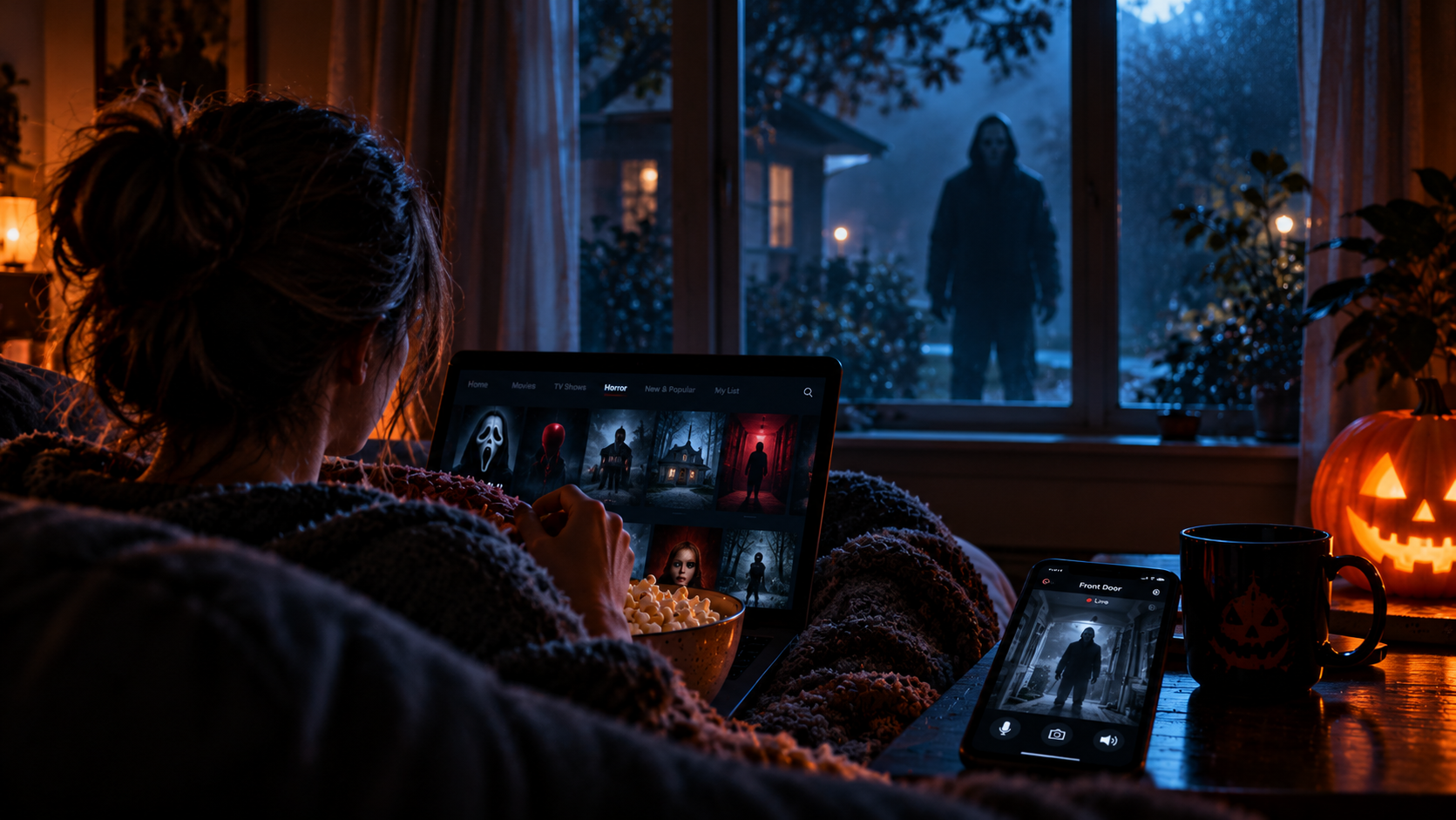
As we prepare for Halloween tomorrow, many of us may settle in to watch a horror film. It might be a favourite, an October classic, or something new we’ve found while browsing a streaming service. In the past, television schedules, late-night movie marathons and trips to the video store shaped how we watched horror at Halloween. Today, streaming platforms make decades of horror cinema available at our fingertips, allowing us to revisit films from almost any era, including those that terrified earlier generations.
But watching these films again raises an interesting question: would some of our favourite horror stories still work if their characters had smartphones, doorbell cameras and reliable internet? It’s tempting to laugh at the choices characters make in older horror films. Why not call for help? Why go into the house alone? Why answer a threatening phone call? Yet perhaps these questions reveal more about how technology has changed our expectations than about the films themselves.
When being disconnected was frightening
For much of horror cinema’s history, isolation has been one of the simplest ways to create fear. A remote house, an empty road, a broken telephone or a car that would not start could leave characters with no help. Audiences understood the danger because communication and mobility had real limits. Filmmakers could build suspense by placing characters somewhere they could not easily reach the outside world, trusting viewers to recognise their vulnerability.
Consider Halloween (1978): much of its tension comes from the vulnerability of ordinary suburban spaces. Laurie Strode cannot simply share her location with friends or check a live camera feed to see whether Michael Myers is outside. Similarly, in The Blair Witch Project (1999), the characters grow increasingly frightened as they lose their way in the woods. Today, audiences might instinctively reach for a smartphone or GPS. Those technologies could, of course, fail, but a contemporary filmmaker would probably need to explain why. These differences do not make the original films any less effective. Rather, they remind us that the suspense was built around the expectations and limitations of the time.
A recent UK survey commissioned by Uswitch explored this idea, asking whether classic horror films might play out differently if their characters had modern smartphones and reliable internet. Half of Gen Z respondents thought some films could end within 30 minutes. Though these scenarios are playful rather than predictions of how the films would actually unfold, they raise an interesting question about technology’s role in storytelling. If modern devices remove some of horror’s traditional obstacles, filmmakers must find new ways to keep their characters vulnerable.
When connection becomes the threat
Modern horror increasingly finds its answer in turning the technologies meant to protect and connect us into sources of danger. Instead of relying solely on isolation or the inability to communicate, contemporary films often explore what happens when communication is unavoidable, surveillance grows intrusive, or technology operates beyond human control. The threat is no longer necessarily that nobody can reach us, but that someone, or something, can reach us wherever we are.
In Unfriended (2014), horror plays out on a computer screen, as social media, messaging, and video calls become central to the threat. The characters are connected, but that connection offers little protection. Host (2020) turns the familiar experience of a video call into a supernatural encounter, making the technology itself part of the story’s setting. More recently, M3GAN (2022) explores the dangers of an artificially intelligent companion designed to offer care and protection. In each film, technology associated with convenience, connection, or safety becomes a source of fear.
This reflects a significant shift in how horror uses technology. Older films often relied on characters’ inability to communicate, while contemporary horror can make constant connectivity itself frightening. A smartphone can summon help, but it can also reveal our location. A security camera can make us feel safe, yet it can also show us something we wish we had never seen. An AI assistant can make life easier, but what happens when we lose control of its decisions? The fear hasn’t disappeared; it has moved into the technologies we increasingly trust and depend on.
Watching yesterday’s fears through today’s technology
Streaming adds another dimension to this relationship by changing how audiences discover horror films from different eras. Halloween once meant waiting for a TV channel to schedule a favourite film, tuning in to a late-night horror marathon or visiting the local video store. These activities helped establish a seasonal viewing ritual, as broadcasters and retailers shaped what was available and when audiences could watch it. Today, streaming services offer Halloween collections, curated recommendations and films from different generations, letting viewers move from Psycho to Scream to M3GAN in a single evening.
Yet streaming does more than make older films easier to access; it also changes how we experience them. A film once watched as part of a television event might now be viewed alone on a phone, while a movie discovered through a video-store recommendation might appear in a personalised streaming row. Films that once seemed terrifying can become comforting annual traditions, especially when we associate them with childhood memories or watching with family and friends. The film itself remains unchanged, but the context of the viewing experience has shifted.
Nielsen’s analysis of US viewing found that horror accounted for 14.7% of movie-viewing minutes in October 2025. Streaming made up 72% of viewing minutes across the ten leading horror titles it examined, though traditional television remained important for some older films. These figures suggest that Halloween viewing isn’t simply shifting from one technology to another; older and newer ways of watching continue to coexist. A classic horror film can still feature in a scheduled television marathon while also being available to stream on demand. Horror has always been about more than being frightened. It’s also about anticipation, nostalgia, and the shared experience.
The fears that technology cannot solve
Of course, not every horror film feels less convincing when judged by modern technological expectations. A smartphone may not protect someone from a supernatural presence, a security camera can’t explain every unexplained event, and reliable internet does little to ease the psychological fears explored in films such as The Babadook (2014) or Hereditary (2018). These stories tap into anxieties technology cannot easily dispel, including grief, loss, uncertainty, isolation, and the fear of losing control.
Perhaps this is why horror continues to reinvent itself. The technologies woven into our lives may change, but many of the emotions that make us vulnerable remain remarkably consistent. What changes is how filmmakers portray those fears and how audiences recognise them. A broken telephone once offered an immediate explanation for why help could not arrive. Today, a hacked camera, an unfamiliar notification or an AI system behaving unpredictably might create the same sense of helplessness. The circumstances have changed, but the underlying anxiety remains.
A paradox also emerges as we increasingly rely on technology for safety and reassurance. The more connected our lives become, the more unsettling it is to imagine those connections failing, exposing us, or turning against us. We install cameras to monitor our homes, share our locations to reassure others, and use intelligent systems to simplify everyday decisions. Yet each convenience brings new possibilities for uncertainty and loss of control. Horror need not invent entirely new fears; it can take technologies we already trust and ask what happens when that trust is misplaced.
Halloween gives us a chance to revisit the films that once frightened us and discover what scares us today. Streaming makes it easier to travel across generations, while the stories remind us how much our relationship with technology has changed. In older films, devices that might have helped characters escape danger are often the same technologies contemporary filmmakers use to build suspense. Technology hasn’t made horror less frightening; it has given the genre new ways to explore anxieties that have always been with us.
So, as you choose a horror film this Halloween, consider what makes it frightening. Is it the danger on screen, the technology that makes that danger possible, or the thought that the systems you rely on every day might not protect you after all?
Latest Posts
- From Region 4 to Streaming: Why We Still Wait for Films
- Has Technology Made Horror Less Frightening or Changed What Scares Us?
- A World of Pure Reimagination: What Netflix’s Wonka Tells Us About Its Future

- Part 2: What My Conversation with Netflix’s Co-CEO Suggested About Netflix’s Next Phase
- Part 1: How My Conversation with Netflix Co-CEO Greg Peters Made Me Rethink What Streaming Means for Netflix’s Future