

Echoes of Screen & Streaming | Part 1 of a two-part series
Last week, I met Netflix co-CEO Greg Peters at the company’s Sydney office during a small media roundtable with three other Australian journalists. The discussion covered live sports, AI, gaming, advertising, personalisation, interactivity, fandom, and physical experiences.
There was no single announcement or neat roadmap for Netflix’s future. Instead, Peters answered questions in detail and, taken together, those answers suggested something more interesting. That the definition of Netflix itself may be broadening beyond being just a “streaming service”.
This is the first of two pieces drawing together what I took from that conversation. In this first part, I want to focus on the platform itself: how streaming might increasingly become a starting point, how personalisation can coexist with shared experience, why Netflix’s approach to live sport may be better understood through events rather than seasons, and whether the old idea of transmedia has quietly become the platform.
Part 2 will move beyond the platform to consider fandom, physical experiences, AI, advertising and the way older media ideas are being rebuilt through new technology.
These two pieces will not exhaust the conversation. Several of the ideas Peters raised, particularly AI and screen production, event-based sports rights, personalisation, local content, interactivity, and the changing economics of media, deserve their own treatment. I will return to several of them in future Echoes of Screen & Streaming pieces.
Streaming may increasingly be the starting point
Early in the conversation, Peters reflected on Netflix’s original ambition to find “the biggest audiences we could find around the world”. Film and television have obviously been central to achieving that, but he also noted that entertainment extends well beyond those two forms.
“There’s more than film and series out there that can entertain folks.”
Netflix has consequently been building capabilities across live events, games, interactivity, podcasts and other formats. Peters described the opportunity as the ability to “orchestrate” an entertainment experience across them. His shorthand for the potential was simple: “One plus one, plus one, equals more than three.”
I think this distinction is important. Individually, these formats are not groundbreaking. Television networks have been creating documentaries on sports for many years. Entertainment brands have traditionally expanded into games, merchandise, and live experiences. Podcasts and behind-the-scenes content are also well-established. What sets Netflix apart is its potential to unify all these elements within a single technological and branded ecosystem.
Peters used football as an example. Around a major event such as the FIFA Women’s World Cup, which Netflix will stream in the United States and Canada in 2027, Netflix could create what he called “shoulder content”: documentaries or series that build interest in the teams, players and stories surrounding the competition. The platform can then carry the live event itself while also offering games and other related experiences.
“You’re just bouncing back and forth between these various different formats.”
The value, therefore, lies in connection rather than mere accumulation. Shoulder content strengthens an audience’s connection to the people and stories behind a sport, while the live event offers a shared moment that anchors those experiences. For example, Drive to Survive has significantly influenced Formula One by showing how a screen series can introduce viewers to personalities, rivalries, and narratives, making the live sport more engaging.
Peters’ response suggested that streaming is not just about expanding the company’s library with more categories, but also about opening the door to a broader engagement with entertainment.
Personalisation does not have to mean isolation
One of the more interesting tensions in the discussion involved personalisation. Netflix has spent years trying to perfect its content recommendations for individual viewers. Peters believes AI can enhance this process significantly. He envisions being able to tell Netflix that you are feeling exhausted after work, seeking something uplifting, nostalgic, or specifically from the 1980s.
That offers a very different discovery experience from scrolling through rows of thumbnails. It potentially makes the entry into entertainment more conversational, contextual and personalised. However, when another journalist suggested the idea of making entertainment highly personalised, Peters was much more sceptical.
“I’m pretty confident that all of us having our own hyper-personalised individual entertainment experience is not a good place.”
His example of why sport matters began to connect several threads of the discussion.
“What’s magic about a football match? We literally are all experiencing the same thing at the same time.”
That comment caught my attention because Netflix has been instrumental in making personalised, on-demand viewing mainstream. The platform’s concept has long involved different people watching various content, at different times, across multiple devices, with recommendations becoming more personalised over time.
Peters’ comments suggest that greater personalisation does not necessarily require the entertainment itself to become entirely individualised. Personalisation can shape how we discover content, how it is presented to us and how we enter an experience, while the programme, film or live event can still become something shared.
The recommendation may be personal, but the destination can remain collective. Netflix can personalise the journey without necessarily personalising the destination.
Live sport: events rather than seasons
That distinction becomes especially useful when thinking about Netflix’s growing involvement in live sport. Peters did not describe it as a conventional rights strategy centred on securing entire competitions. Instead, sport was framed as part of a broader live-event strategy, with emphasis placed on particular occasions, rather than the season itself.
This could prompt us to reconsider sports media rights, not only from Netflix’s viewpoint but more generally. A game can remain part of a league or competition while also being promoted as a standalone event. People attend because of the importance of the moment, rather than just the next fixture in a season.
I asked whether Netflix’s vast viewing data from sports documentaries and related content shaped its selection of sports for live broadcasting rights. Peters indicated that this was not a major factor in their decision-making. While Netflix certainly has comprehensive audience insights, he did not suggest that documentary viewership serves as a predictive indicator for selecting which sports to focus on.
My interpretation of the overall strategy is quite the opposite. When Netflix secures a live sporting event, it opens the door to develop related content such as documentaries, podcasts, games, or other materials. These can enhance audience engagement with athletes, teams, and narratives. Therefore, obtaining event rights often serves as the initial step in a broader content strategy rather than its final goal.
Netflix has previously leveraged Christmas NFL games as significant live occasions. The approach extends naturally to specific matches like the recent Los Angeles Rams–San Francisco 49ers game held in Melbourne, Australia. While technically part of the regular season, hosting an NFL game in Australia elevates it beyond a standard fixture. It turns into a unique cultural and sporting event capable of drawing audiences who might not usually follow either team.
Netflix’s baseball content offers another example of this logic. Opening Night and the Home Run Derby are inherently unique events, while MLB at Field of Dreams showcases the event-based approach. Hosting a regular-season game at a location renowned from the 1989 film adds a cultural layer beyond just the game itself. It merges baseball, nostalgia, and film history into a single, meaningful occasion.
This creates an interesting distinction between sports rights and event rights. Traditional sports broadcasters often depend on the season, with recurring fixtures, habitual audiences and the expectation that viewers return every week. Netflix already has a recurring relationship with its audience through film, television and the wider platform. Live sport can therefore serve a different function. It can create concentrated points of shared attention within an environment otherwise built around individual choice.
The true value might not be in owning the entire competition but rather in securing the event and creating a more comprehensive entertainment experience around it. I think this distinction deserves a fuller article, especially as Netflix and other platforms keep transforming the connections between sport, entertainment, and media rights.
The personal, the local and the global
The tension between personalisation and shared experience also involves a cultural aspect. Shared experiences don’t have to mean everyone watching the same program at the same time, they can occur at different levels too.
Netflix stands at a unique intersection of the individual, local, and global spheres. Its technology can customize what appears on my screen, while the content it suggests can still be strongly linked to specific places, languages, or cultures. Therefore, personalisation doesn’t have to lead to cultural division; it can also serve as a tool for exploration.
A recommendation might highlight an Australian production I missed or showcase a program created far away in a language I do not speak. That programme can remain culturally significant in its original country while also reaching completely new audiences globally.
Questions about what gets commissioned, promoted, and surfaced in such a system are valid and deserve their own focus. Peters’ comments made me consider how personal discovery, local identity, and global culture might increasingly work together instead of just competing.
Maybe transmedia became the platform
This movement between formats led me to ask Peters about something we talked about frequently a decade ago. The core concept is that audiences can navigate a narrative universe through various media forms, such as a TV show expanding into a website, a game, social media, or other experiences.
Netflix explored this concept with interactive titles like Puss in Book and, most notably, Black Mirror: Bandersnatch. I was eager for that kind of interactive storytelling to succeed. Having grown up reading Choose Your Own Adventure books, I shared this with Peters during our chat. However, Bandersnatch always seemed limited by its technology. The branching paths were clear: a choice showed up, a timer ticked down, and you made a selection.
Peters acknowledged that technology was part of the problem: “The technology at that point in time wasn’t quite there.” He discussed how newer interactive experiences can make better use of the phone as a controller and the capabilities already in our hands.
That point is important to remember. The phone could serve as a link between Netflix as a streaming platform and a more interactive experience. It doesn’t necessitate purchasing a new console or device since the hardware is already available; the Netflix app can act as the interface.
But his answer also made me reconsider transmedia itself. Traditionally, transmedia often meant leaving one medium to find another piece of the story somewhere else. What happens when the platform can increasingly coordinate those experiences itself?
Watch something. Play something. Listen to something. Explore its production. Attend an event. Buy something associated with it. Eventually, perhaps, physically enter part of its world.
Maybe transmedia did not disappear. Maybe it became the platform.
Where Part 2 goes next
Overall, these ideas suggest that Netflix’s future might not rely solely on expanding its streaming library with more content. Instead, a more important growth area could be its capacity to integrate discovery, storytelling, live events, games, and other experiences centered around audiences and intellectual property.
But this prompts another question: if streaming becomes the starting point rather than the destination, what happens after we press play?
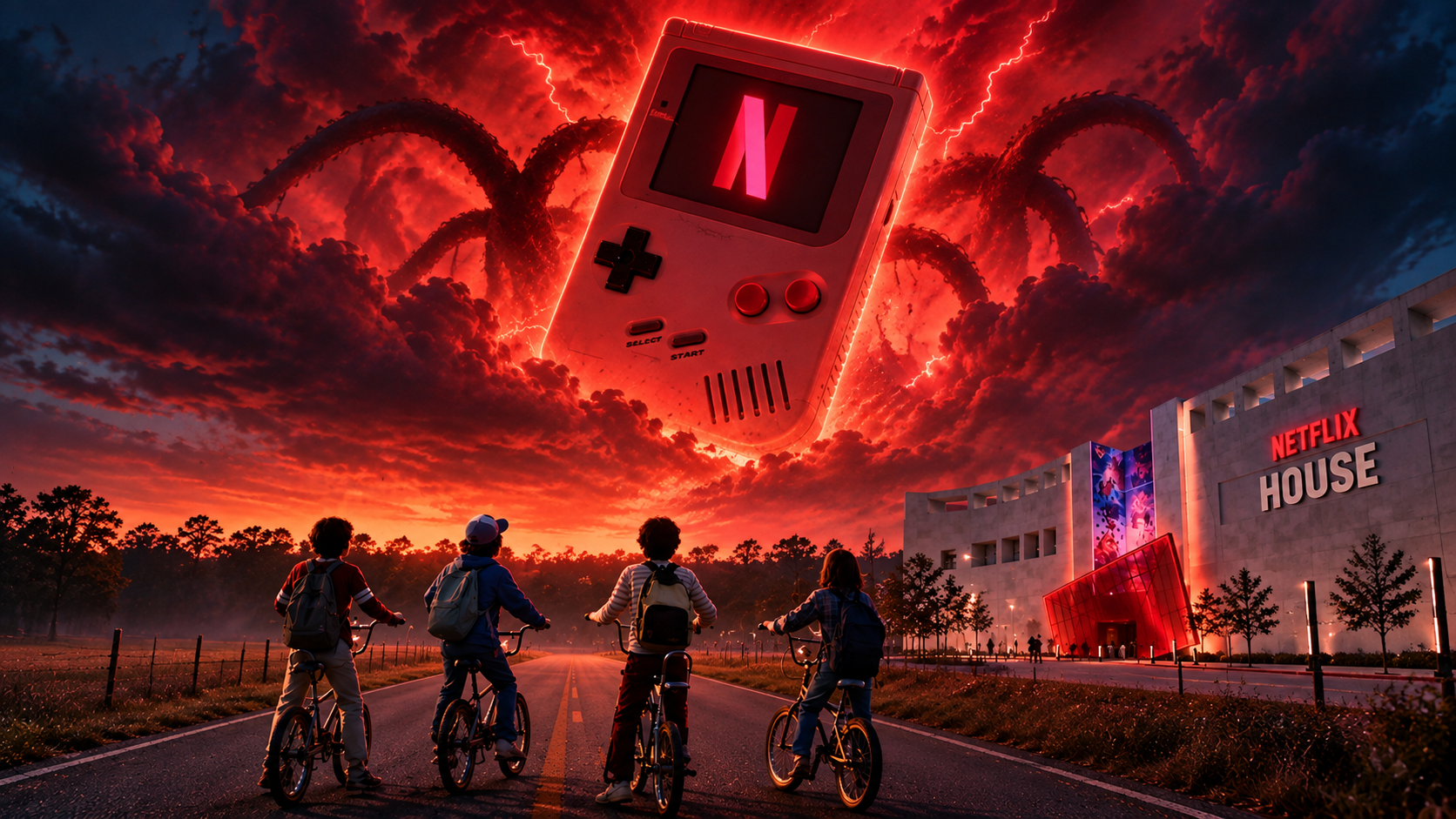
In Part 2, I will revisit my discussion with Peters to examine fandom, the resurgence of something resembling DVD extras, Netflix House, AI and the economics surrounding creativity, advertising that starts to resemble entertainment, and an unexpectedly revealing conversation about a hypothetical Netflix Game Boy.


[…] Part 1 of this two-part series, I examined what my discussion with Netflix co-CEO Greg Peters revealed about Netflix’s shift […]