
Today, we can watch films almost anywhere, on any screen. So why does where we live still determine when we get to watch them?
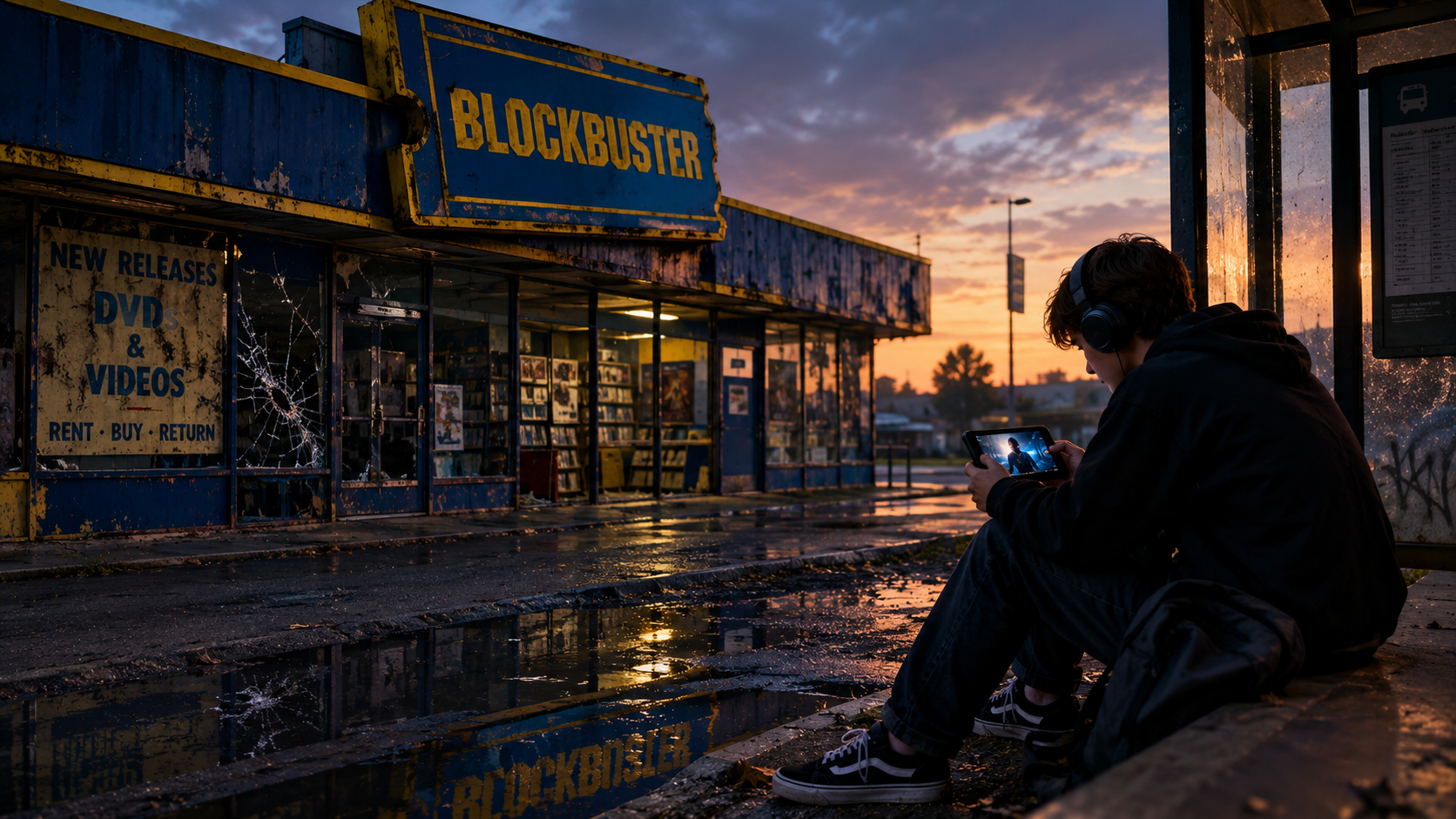
There was a time when watching a film at home meant waiting. You might have seen it at the cinema, missed its theatrical run, or heard of its success overseas. Then came the wait. Eventually, it showed up at the local video shop (If you are too young to know what this is, you’ll need to Google it).
Today, that experience feels distant. Films can move from cinemas to digital rentals and streaming services within weeks, while some skip cinemas altogether. Yet when a film becomes available remains surprisingly complicated. Distribution and viewing technology has changed, but the wait has not disappeared.
When films travelled slowly
For much of cinema’s history, studios released films in stages to generate value from different audiences. A film might premiere in major American cinemas before reaching smaller towns or international markets. Later, it could become available on home video, pay television, and eventually free-to-air television. These delays were not necessarily technological requirements, but commercial decisions.
Each release window created an opportunity to sell access to the same film in a different way. The arrival of VHS transformed this system. For the first time, audiences could routinely rent a relatively recent cinema release and watch it at home. This did not eliminate theatrical exclusivity. Instead, it added another valuable stage to the film’s commercial life.
Australian research published in 2013 examined theatrical-to-video release windows from 1984 to 2010. By 2010, the average delay had fallen to about four months. Although the wait had shortened considerably, it remained an established feature of the industry’s commercial value chain.
The strange geography of DVD
DVD promised a major improvement over VHS. The picture was clearer, smaller discs, and films with menus, subtitles, alternative audio tracks, and extra features. Yet the format also introduced a curious contradiction. Though marketed internationally, DVD divided the world into 8 playback regions. The regions were as follows:
- Region 1: United States, Canada and US Territories
- Region 2: United Kingdom, Europe, Japan, South Africa and Middle East
- Region 3: Southeast and East Asia
- Region 4: Australia, New Zealand, Pacific Islands, Central and South America
- Region 5: Former Soviet Union, Indian sub-continent, Africa, North Korea and Mongolia
- Region 6: China
- Region 7: Reserved for future use
- Region 8: International territories (cruise ships, aircraft etc)
This meant a film could be available on DVD in the United States, but an Australian consumer who bought that disc might find it wouldn’t play on their DVD player, since both discs and players were region-coded.
The restriction was more than a result of differing television standards. In December 2000, the Australian Competition and Consumer Commission raised concerns about DVD region-coding restrictions, including their impact on consumer choice and imported discs. The issue was not whether the technology could deliver a film. It was whether the technology would permit access.
Region-free DVD players offered a way around some restrictions, but they also exposed an underlying contradiction: the same film could be commercially available in one country yet remain technologically restricted in another.
Streaming was supposed to change everything
When streaming became mainstream, many physical constraints of film distribution seemed to disappear. There was no disc to manufacture, shipment to organise, or video shop to stock. In principle, films could become available worldwide at the same time, right?
Well, to an extent. Digital distribution did not make films universally available. A title might appear in one country’s Netflix catalogue but not another’s, leave one platform and arrive on a competitor, or be available overseas but missing from the catalogue for Australian audiences.
Rather than DVD region coding, audiences encountered territorial licensing, catalogue restrictions and geographic access controls. These systems differ: DVD regions limited playback via physical media and hardware, while streaming restrictions generally rely on rights agreements, account territories and network-based location checks.
But both reveal that a persistent industry principle of controlling where audiences can access a film can be commercially valuable.
The shrinking release window
What has changed dramatically is the speed at which films can move between distribution channels. The pandemic accelerated experiments with simultaneous cinema and streaming releases, premium digital rentals, and shorter periods of theatrical exclusivity. Some of these experiments were temporary, while others became part of longer-term distribution strategies.
Recent research into the United Kingdom’s 2025 film releases reveals just how varied these arrangements have become. A report published by Official Charts PRO and Fabric Insights found that Disney+ had an average gap of just 26 days between a film becoming available through transactional digital services and its arrival on subscription streaming. By comparison, Sky’s NOW service averaged 221 days. The report also found that 25 per cent of films reached transactional services within a month of their theatrical release, while only 10 per cent took more than 60 days.
More interestingly, the report found a link between the length of release windows and theatrical box-office performance. Films that took more than 200 days to move from transactional availability to subscription streaming earned an average UK box office of £12.6 million, compared with £8.4 million for films that made the transition within 100 days.
This raises an interesting question: do longer release windows help films generate more revenue, or are commercially successful films simply more likely to be given longer exclusivity periods? The figures suggest a relationship, but they do not establish which is driving the other.
It’s also important to distinguish between the windows being measured. The 26-day and 221-day averages don’t represent the time between a film’s theatrical release and its streaming debut. Instead, they measure the gap between two forms of home viewing: renting or buying a film digitally and watching it through a subscription service. A film may spend months in cinemas before becoming available to rent or buy, then arrive on a subscription platform just a few weeks later.
The industry’s release windows have not simply become shorter. They have become more varied. Studios and platforms now differ in how long audiences must wait, what they pay, and where they can watch. And perhaps that is the more significant change.
The question is no longer simply how long we wait for a film, but who decides when that wait is over.
Who benefits from making us wait?
For cinemas, an exclusive theatrical window offers an opportunity to attract audiences before a film is available at home. For studios, different windows can generate distinct revenue streams. For streaming platforms, early access to popular films may attract subscribers or reduce cancellations.
For audiences, the calculation is different. A person who wants to see a film might have to decide whether to buy a cinema ticket, rent it digitally, wait for it to appear on a subscription service, or find that it is unavailable in their country.
There is also an important distinction between access and ownership. A VHS tape or DVD could remain on a shelf for decades. A film licensed to a streaming platform can disappear from its catalogue. Physical media had territorial restrictions, but it also offered a form of continuing access that subscription services do not guarantee.
From Region 4 to a borderless world?
Film distribution is often described as a story of technological progress. VHS gave audiences more control over when they watched films, while DVD brought better quality and greater convenience. Streaming eliminated the need for physical media and made vast catalogues available almost instantly.
Each innovation broadened what was possible, while also creating new opportunities for distributors to organise access around commercial priorities.
The most significant change may not be that audiences wait less, but that the mechanisms deciding who waits, where they wait, and what they must pay have become less visible. A DVD player rejecting a Region 1 disc made its restrictions obvious. A film missing from a streaming catalogue may offer no comparable explanation.
Perhaps the question is no longer simply how quickly films move from cinema to streaming. It is why, in an age of almost instantaneous digital distribution, access to culture still depends so heavily on geography, licensing and commercial timing.
If technology makes films easier to distribute than ever before, should audiences still have to wait because of where they live?